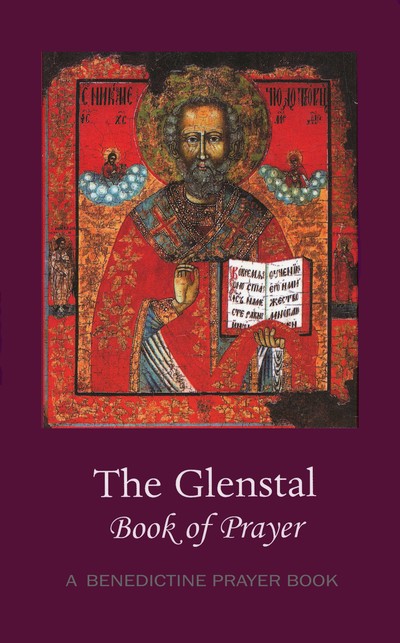
A popular, pared-down version of the Liturgy of the Hours, very good for busy laypeople. Saint Nicholas graces the cover.
Recently, my husband and I went on a weekend retreat to a Benedictine abbey a mere 23 minutes from our home. It was an undirected retreat, meaning that our time was ours to structure as we saw fit. We went on a lot of very peaceful and renewing walks, spent time in the chapels, had a nap or two, did some reading and talking, and enjoyed partaking of the meals that the monks kindly provided for us in the guest dining room. We enjoyed their friendly warmth and good humor, too. The Benedictine order sees hospitality to all comers as central to its mission, taking its cue from the fifth-century Rule of Saint Benedict, which states that “guests are never lacking in a monastery.” According to the Rule, the monks or nuns consider that they are hosting Christ when they host their guests.
But probably the most surprising thing that happened during our retreat was how endeared we both became to the Liturgy of the Hours (also called the Divine Office or Breviary). Before that weekend, we had basically zero experience of the Hours, even though the Hours are a form of Christian prayer that is emphatically not reserved just to clergy or consecrated religious — though these folks have become most often associated with it. But laypeople are also encouraged to pray the Hours, in private and to whatever extent they are able in the circumstances of their days.
What are they? Well, the Hours are organized prayers that consist largely of psalms, juxtaposed with other prayers that have come down to us over the centuries from the early tradition of the Church. The Liturgy of the Hours is observed (under varying names) by the Catholic, Eastern Orthodox, Oriental Orthodox, Anglican, and sometimes Lutheran traditions. The full Liturgy contains 7 daily prayer times, each ranging in length but none exceeding 20 minutes or so; several of them are a good deal less. As a layperson, you can choose to do one or all of them. Each day has different psalms and prayers — variety is the spice of life, after all. Two of the daily prayer times are singled out as the most important of the day. These are the morning and evening prayers, also referred to as lauds and vespers, and are considered the “major” hours; they represent praise and thanksgiving. There are other, shorter prayer times for the mid-morning, noon, and mid-afternoon (terce, sext, and nones); these are known as the “minor” hours. Finally before bed, there is night prayer, called compline. Perhaps the Liturgy of the Hours, in concept, is similar to the well-known Muslim practice of prayer five times a day. Pope Francis has said that he “loves praying the breviary” each day.
So what did my husband and I find so special about these prayers that I am sitting here at the end of a busy day, gushing about them on the internet? I’ll try to explain. When we were staying at the abbey, a large old-fashioned bell would ring precisely ten minutes before each of the Hours that that community observed (they didn’t observe the minor hours of terce and nones, or at least not all together in the church; they may have done so individually on their own time). Hearing that bell and going to the sacred space of prayer time — literally and metaphorically — became such a steady, gentle rhythm in our short time there that it was the thing we missed the most when we left. We didn’t plan for that, either. When we arrived, we figured maybe we’d go to a couple of prayer times. But after the first one, we just kept on coming back like we couldn’t get enough. When we first arrived, one of the other visitors said to us, “There’s a rhythm to the life here. It really grows on you.” It didn’t take very long for us to understand what she meant. There is a refuge in the prayers, a gentle communion with the divine that keeps you wanting more.
And now, here in our home? After a few weeks without the Liturgy of the Hours, we picked up over the weekend a copy of The Glenstal Book of Prayer: A Benedictine Prayer Book. This wonderful little book out of Glenstal Abbey in Ireland became a bestseller, and is now the source for our simplified Liturgy of the Hours in our lives. My husband can do one or two of the Hours each day, usually vespers and/or compline; due to my more flexible schedule I can do more on most days if I choose. The point is that these prayers are not a requirement or some obligation: they are a great and marvelous opportunity to be entered into freely. As the Glenstal Book of Prayer says in its introduction:
Prayer is the movement of the Holy Spirit in the human heart through which God reaches out and embraces human beings. It is a duet of love in which the action of the Spirit inspires and sustains us in the darkness of faith. It is an inward call from Christ who dwells within the depths of the human soul, and who longs to be known and loved there. It is the exciting adventure of the search for God’s presence and the endless joy of rejoicing in it when it is found. It is the growing perception of the infinitely gracious, infinitely merciful Source, the Father who reveals the beauty of his face to the inner eye of the heart and the sweetness of his voice to the inner ear attuned to listen.
© 2014 Elizabeth Keck


 The Thoughtful Theist