Lions Roaring

The other day, my husband, daughter, and I went to a zoo — a good one, where the animals are well cared for and occupy spacious outdoor areas that approximate their natural habitat. We had a wonderful time with all the animals, as we always do, but the crowning moment this time came at the end. We overstayed our welcome a bit by taking our time leaving after the park closed at 5 pm; at least the zookeepers don’t seem to mind too much. But this time, we were later than usual, and thus we were in time for the lions to arouse from their slumber.

Every time we’ve been to the zoo, the two lions — one male, one female — have spent their time stone-cold unconscious on their lawn, as if passed out from a long night of too many cold beers. This, of course, is their prerogative, since they are nocturnal creatures. But this is the time of year when the sun begins to go down noticeably earlier, and thus its rays were getting decidedly longer when we heard the first series of roars.

We were not too far away from the lions, but clearly their bellows could be heard throughout the entire zoo (and probably the adjoining neighborhood), as fellow overstayers-of-welcome began to arrive in groups shortly after the lions let us all know they had returned to the land of the conscious. I stood there with my mouth open while the male lion sent forth several long bellows followed by a series of short barks. At this, the female emerged from their house-shelter and joined the chorus, both of them seeming to answer the other, yet not facing the other, but rather some invisible point in space unknown to the rest of us.

Each time their interchange would end, they would lie down in separate places for 5 minutes or so, then one of them would get up and start roaring again; unfailingly, the other would rise and roar in response. It is hard to convey how thrilling this was to hear and to watch. The sound that came from these animals literally echoed through the entire park; if you were standing next to them as we eventually were, the sound overpowered you so much that you felt you were hearing it within your very bones, not merely your ear drums. There was no other sound.

So this got me to thinking about how drawn we are to all the big cats: lions, tigers, leopards, etc. The zoo also has two tigers and one leopard, and the response of the human onlookers is always the same to all of them: awe, admiration, fascination, respect. We think they are beautiful, and we are mesmerized by their barely-restrained power. We might love the cuter, sometimes also majestic prey animals, both large and small — like the various primates, tropical birds, turtles, prairie dogs, porcupines, llamas, kangaroos, camels, elephants, capybaras, tortoises, zebras, and more. We are charmed by them, curious about them, attracted to them. But there is something about those big cats and their raw, frightening power, combined with their cool composure, that seems to elicit the same reaction from everybody: a magnetic fascination and a formidable respect.

As this was in the back of my mind, I also happened to watch The Godfather. Aside from the artistic achievement of the film itself, it got me thinking about why we are drawn to mafia characters, particularly the dons. We are utterly fascinated with them, though we know their lifestyle is unlawful and in many ways detestable. Yet knowing this, we sometimes feel a contrarian respect at the same time, as I did for Don Vito Corleone while  I watched. True, he was portrayed in a way that showed not only his criminality but many dimensions of his full humanity as well, so perhaps that helps to explain it. But in movies, books, and television, we have to admit we can’t get enough of these characters. The Godfather series is only one example; the huge success of the TV series The Sopranos is another. And while we might not respect the mafia in real life, when their criminality is too stark and uncomfortably close to us, the fact remains that we are still fascinated by them. We buy books about them (Black Mass, for example), and we flock to semi-nonfictional depictions of them in films (The Departed and Donnie Brasco, for example).

As far as the fictional stories go, it is their fictional nature that allows us to observe that underground world with undisguised engagement for some discrete period of time without needing to worry about any of it being real — without needing to respect any of the real mafia bosses whose actions in the real world we disgust. So why do we feel such magnetic draw, and even that strange, grudging respect for these characters? I believe it is the same reason that we are drawn to the big cats, with all their undulating muscles; their raw power simmering just beneath the surface of their skin; their shocking roars that we seem to hear in our very bones; the chills of fear, fascination, and respect all at the same time. It is the rogue aspect to the existence of both the big cats and the mafia personalities; their power; and perhaps above all, the perception of their self-determination that stirs in us these strange and contrarian reactions.

Fundamental to us as humans is an inherent resistance to being told what to do. We manifest this resistance early in life as toddlers (as every hapless parent such as myself knows), and it does not vanish with the coming of the years. It is tempered by our upbringing, by civilization, sometimes by religious convictions; but it remains beneath the surface, sometimes like a still lake, and sometimes like a pot of water so close to boiling point that one object thrown into it will make it explode. It is the reason “reverse psychology,” the practice of advocating the opposite of (or even indifference to) the desired result, works so well. It is the reason that when we are in school or college, we instinctively resist reading books that we are assigned to read — books that, left to our own devices, we know we would enjoy reading. It is the reason there is so much resentment toward the perception of “nanny government” or “Big Brother.” It is the reason that we feel a secret little thrill when we flout some small law, like overstaying our parking meter without getting caught, or like successfully pulling a U-turn against the sign that says not to, or like performing some small home improvement in our houses without appearing at town hall to ask permission and pay for permits. Someone of a certain age, whom I know, recently said, “These days you can’t lean two sticks together without needing 5,000 permits.”

Unfortunately, it is also part of the reason that some people are attracted to violating larger laws, laws meant to protect all of us dwelling in peaceful society. Mafia dons would, of course, fall into this category. Even though Mafia dons radiate self-determination of a criminal variety, there is something attractive about self-determination itself. In civilized society, it manifests itself by the will to vote, or by anti-regulation sentiment, or by quitting one’s job and deciding to employ oneself so as not to have to live by someone else’s desires and rules. When that JetBlue crew member summarily renounced his job by announcing over the loudspeaker, “I’m outta here!”, inflating the emergency slide, and grabbing a cold one on his way out, we laughed and we cheered for him. Despite the famous Beatitude, we tend to value the bold, and we tend to value the meek only when they can make themselves be bold. I certainly don’t think that’s the way things should be; we would have a kinder, less violent society and a kinder, less violent world if we consistently took that Beatitude as seriously as Jesus wanted us to.

But I do wonder if all this is part of the same undercurrent in our minds that causes us to shiver with reverential delight at lions, tigers, and leopards when they are guaranteed not to hurt us. Whether it is or it isn’t, I do know that I’ll never forget that almost mystical thrill we all felt when we stood there in our favorite zoo. Because we had heard and seen the lions roaring.

© Elizabeth Keck 2010
History Repeating

This week, I’ve been thinking about the Medici family, the elected rulers of Florence in Renaissance Italy. In a way, we have the Medicis to thank for the Renaissance, with their patronage of artists who turned out to be some of the greatest of the Western world – Brunelleschi (who discovered the technique for perspective in art and was also an unparalleled architectural genius), Botticelli, da Vinci, and Michelangelo. Later, the Medicis also were the patrons of scientist Galileo Galilei, who tutored more than one of the Medici princes. Without the Medici, there quite simply would have been no Italian Renaissance (at least not as we know it), and Florence would not have become the cultural and artistic center of Italy to give birth to that Renaissance.

Aside from all this, I was thinking about the Medicis in the context of why we value what we value, and how what we value shifts over time and place. We, of course, imbue things and ideas with value ourselves. Value is a product of our own minds. Not long ago, gold became valued at over a thousand dollars an ounce; but gold in itself carries no “intrinsic” value at all. If we as people did not desire gleaming jewelry, gold would be worth almost nothing. Similarly, if there were an overabundance of gold, such that some could be found in almost everyone’s backyard, it would not be worth more than quartz, monetarily. Ideas, no less than objects, are also subject to the same vagaries of value assigned by the human mind.

The Medicis valued power, make no mistake; but, particularly in the earlier stages of their dynasty, they also valued art and free thinking. The city’s mood was ripe for this, for it coincided with the changing spirit of the times. For a while, under their auspices, Florence flourished into a haven for cutting-edge painting, sculpture, and even architecture (Brunelleschi engineered Il Duomo based solely on extrapolation from classical Roman domes, which no one remembered anymore how to build). Artists under the auspices of the Medici had free rein, and even encouragement, to explore artistic subjects outside merely Christian religious art, which until this time had had a monopoly. Particularly under Lorenzo dei Medici, Florentine art schools burgeoned; and it was Lorenzo who spotted the extraordinary talent of a 10-year-old named Michelangelo Buonarotti, and took him into the Medici household.

But in time, there was a conservative religious backlash, driven by the extremist monk Savonarola, who preached damnation on what he thought was a hedonistic city that valued “pagan” art and ideas more than the Holy Church. He saved his most vicious commentary for the Medici family, whom he preached were damned for sponsoring un-Christian and immodest art. Savonarola was able to whip the populace into such a frenzy that the Medici were (temporarily) ousted into exile, the art and ideas that they had helped foster no longer valued by the people at all. Now feared as irreverent tools of the devil, extraordinary works of art were thrown onto bonfires, along with books, jewels, and cosmetics. This was a kind of temporary reign of terror, in which all that had been a source of pride and valued so highly by the city suddenly possessed no value at all. Even Botticelli, who had taken pride in his daring art, was struck by the fear of God and threw his own work onto the great fire.

That particular religious backlash would pass, but the Church as a whole still retained the highest power — and value — in European society. That would be slow to change. Martin Luther and the subsequent Protestant revolution set in motion a gradual chipping away of the Church’s power. But before much of that power was gone, it was the Church that determined what was to be valued by the people. The Inquisition created the Index of banned books, which included works by the classical writers as well as modern works of science. Galileo, who had been supported by the Medici, was not spared the Inquisition, and was forced under pain of death to recant his published theories that the planets and the moon were not perfect heavenly spheres, and that the Earth revolved around the sun. Not even the Medici could protect Galileo anymore. While the society was thirsty for new ideas and discoveries, and while these were gaining value in much popular view, even the Medici could not trump the pope.

Fast-forwarding to the modern day, we have a situation that is nearly the complete reverse. As a society, on the whole we value the discoveries and the methodology of science more than the input of religion in the public sphere. We value national freedom, while once we valued the “divine right of kings.” We value individual freedom and self-expression, while for a long time we valued conformity. We value all people as equal, while once we valued only some and enslaved others, then degraded them for a hundred years after their slavery ended. We value the contributions of women outside the home now, while once we thought there was no such value. We value natural, even organic food, while once we were enthralled with artificial ingredients and pre-processing. We value religious freedom, while once the Puritans executed people and cast others into exile, despite having been persecuted themselves in their ancestral countries. Some of us are valuing more and more the civil rights of gay people, while once we told them that such an identity was no valid identity at all. There are hundreds of other examples, some of which continue to take shape on a daily basis. This is not to say that all these changes in values are uniformly held by all members of our society, but there has certainly been a sea change from the past in many ways.

I was sitting in a cafe this morning eating my breakfast while reading, and the waitress ruminated as she gazed out the window that she used to live in California and loved it, but also liked it here, so she wished that she could go back and forth between the two, maybe have two homes. I’d guess she was in her 50’s. Then she looked at me with quick certainty and said, “I will someday. I will.” And I’ll tell you I didn’t doubt her. To her, that kind of joyful back-and-forth was something she valued so much that she would tell it to a new customer even before she asked my name. Yet I know someone else who feels that the best thing a person can do is stay in the area in which they grew up. Neither of these lifestyles has intrinsically more value than the other — only the value that is perceived by the advocates of each.

We are at a point in our society where we are assessing what we value. Elections are approaching, and the country is divided politically and ideologically. People are fighting about which of our national values are more important, and even which are valid at all. The only certainty is that the dispute over which ideas and philosophies have more value than others is  history repeating itself of the first order. Just as in the days of the Medici.

© Elizabeth Keck 2010

More than Lip-Service for a Legacy

Anyone who follows the news knows that the topic of Islam in America has been a leading headline lately.  The word “Islamophobia” is popping up on various media outlets. A nationwide controversy exists over whether a New York Muslim community can have a mosque within an Islamic Center that would also include spaces  for members of other religions, including Christians. The Center would also include recreational spaces where people of various backgrounds could come together and get to know each other. But the controversy exists because the Center would be a few blocks from the Ground Zero of the horrific 9/11 attacks. It is worth noting that, as General Colin Powell stated on The View this morning, the plans for this Center had existed for quite some time without any uproar over it, until certain media outlets publicized the story. And one would have to be living in a cave not to have heard about the other major controversy: Terry Jones, the clearly attention-hungry pastor of a small church in Florida, plans to burn copies of the Qur’an on Saturday, the anniversary of 9/11.

Add to these the fact that a number of average Americans are becoming louder and louder about their broadbased anti-Muslim sentiments — no longer even feeling it necessary to couch anti-Muslim rhetoric in a veil of American religious tolerance — and it is no wonder some people fear that “Islamophobia” is getting to be a real problem in our country. The Washington Post came out with a poll saying 49% of Americans now have an unfavorable view toward Islam; mosques are becoming sporadic targets, with a mosque outside Fresno, CA having been vandalized more than once.

The broader issue in our society should not be about whether any given person “likes” or “dislikes” Islam as a religion, or whether a person is afraid of it or has any interest in it at all. All that should be secondary and is a private matter to each person. The issue at hand is about upholding the American Constitution and the legacy of freedom and tolerance of which Americans claim to be so proud. Upholding that legacy cannot merely be about lip service, or merely be about groups with which we identify or to which we belong. If we argue for the rights and human dignity of only those groups to which we ourselves belong, such clannishness hardly does honor to the American traditions we were all taught in school, and is hardly something for which we ought to pat ourselves on the back as inheritors of the American tradition.

Some people fear Islam as a “violent religion,” pointing to the horrifying events of 9/11 and the acts of terrorism that have occurred around the world since then. But the fear that Islam is in general a violent religion is typically born from a lack of real exposure to ordinary Muslims and what they believe, and how they live. I do not live in an area with a particularly high number of Muslims, but for whatever reason, there are still several people in my life who happen to be Muslim. They are ordinary families consisting of a husband, wife, and kids; regular people with regular family dynamics, not strange folk with opaque practices and sinister intents, but normal, kind people who are pleasant to be around and care about the same things my own family does. One of these families routinely gives us abundant produce from their own garden, and has shown us impeccable hospitality.

Do these families pray to God? Yes. Are they extremists? No, and whenever the subject has come up, they have unfailingly expressed frustration and dismay that the actions of terrorist extremists have tarnished and misrepresented ordinary Islam across the globe. One of them lamented to me that Islamic radicals espouse beliefs that are nowhere in the Qur’an and that are not properly Muslim, but rather part of local pre-existing cultures that would exist whether Islam were the local religion or not. Such radicals claim to act in the name of Islam, but in reality, act only according to their own criminal intent. In the words of one Muslim woman I know: “That is not Islam. They are not human. They are worse than animals.”

Indeed, if one takes a small effort to learn about Islam, one learns that Jesus and Mary are held in very high esteem in the Qur’an; this fact would surely surprise many Americans who hold blanket assumptions about the Qur’an. Jesus is not considered divine, but he is considered the greatest of the biblical prophets. If one takes a small effort, one learns that the Qur’an states: “Anyone who kills an innocent person, it is as if he has killed the entire world; anyone who saves an innocent person, it is as if he has saved the entire world.” Such a doctrine is hardly in line with radical terrorist mentality.

But this should not surprise us. People have always and everywhere killed in the name of every religion, including Christianity. The religious wars between Catholics and Protestants that blighted Europe for centuries bear bloody witness to this. Were the killers on either side truly acting in the name of Christianity? No, they were acting in their own name, and justifying their own intent by trying to wield a religious motivation. When Jesus said, “I come bringing not peace, but a sword,” it was not an admonishment for his followers to go out and slaughter people; it was a recognition that his movement would change things in a way that, at least in this world, had the potential to introduce havoc and conflict. And it did.

The Qur’an is not a terrorist tract, but if the pastor in Florida insists on burning it, he will galvanize terrorists who use it as a front for their own murderousness. He will feed terrorism, and give the terrorists another reason to attack both us and innocent people abroad, including our troops. But I suspect that perhaps he does not care about that; he does, after all, now have an international stage, and has tapped into a fear that is bubbling close to the surface in this country. This morning, an otherwise friendly and rational person suggested to me that maybe Muslims in America should just live in their own areas, separate from the rest of us, leave us alone, and never the twain should meet. This person did not seem to realize that without groups having real, everyday-life exposure to one another, there is nothing to dispel misunderstanding and fear of the other. And then mistrust and violence receive a blank check.

© Elizabeth Keck 2010

Postscript: Since this writing, the media has reported that Terry Jones, the pastor of the Florida church, has canceled his book-burning.

An Epiphany at Home Depot

I was in Home Depot the other day and got to thinking about how our culture has changed. Specifically, how it has changed in terms of the way people interact with one another. Yes, it’s in vogue now to write articles and even books on whether technologies such as email, texting, Facebook, and Twitter have brought us together or moved us further apart, or some combination of the two; but that’s not what I’m doing right here. Personally, I am always a little irked when I hear that “social networking” technologies do not bring people closer together, but rather the opposite, and that they take pride of place among the modern innovations contributing to the assured decay of society as we know it. Such grand conclusions irk me because it is only through Facebook that I have reconnected with friends who were once a daily part of my life, with whom I had lost touch over the natural course of things. Texting allows me to communicate quickly in the midst of a busy day with those who are close to me. There are also various parts of my life that sometimes make it difficult to carve out a significant block of time for phone calls — not to mention the fact that I’ve never really been an enthusiastic phone person. Trying to have an in-the-moment conversation with someone without seeing any of their facial expressions can make for some really weird conversational dynamics.

But I digress. I was in Home Depot the other day with my small daughter, looking for “odorless mineral spirits.” (Yes, that’s its actual name.). Such mineral spirits were going to aid me in the vexing task of prepping our bathroom walls — long the sorry victims of decades-old wallpaper from a bygone era — for painting. I was on my way to the aisle when I passed a kindly gentleman in his senior years whose job it was to stand near the entrance and answer questions and direct people. Figuring that I knew where the mineral spirits were, I intended on giving him a polite nod and passing by. He, however, was enthralled by my (admittedly adorable) daughter and promptly engaged her in conversation. Having recently blossomed into a social butterfly, the likes of which my rather solitary nature has never managed to approach, she complied. The next thing I knew, I too was welcomed into the gentleman’s conversation, and what I thought would be a passing nod became a real interchange among strangers.

The gentleman informed me that his wife helped their local church set up for an annual flea market that was only a few weeks away, and I should remember to go, since I might find some little thing for my daughter. When he told me the name of the church and the town (which is next to the town in which that Home Depot resides), I replied that I in fact live in that town with the church, and it is right up the street from me. Delighted, he said that he lived in my town and even told me his name, street, and described the exterior of his house and the house next to it. In a very easy way, he extended his hand and asked what my family name was, as if it were the most natural thing in the world. I shook his hand and told him. He said if I ever went by his street, stop in because the missus would love my daughter. Then he bade me goodbye and went to help someone else.

I was left with a very warm feeling and a bunch of thoughts about how our American society has changed. Or, if not all of America, at least certain areas and certainly Generation X and below. If that helper at Home Depot had been someone of my generation (I shall coyly state that I am somewhere just north of 30), there would surely have been no spontaneous engagement of my child in conversation — but there would not even have been an unsolicited engagement of me, a peer, in conversation. We would have politely let each other be and never discovered that we live in the same town. I would not have learned about the local flea market, and I certainly would not have been extended a hand, informed of a family name, street, house exterior, and asked for my family name; and never in this time-space continuum would I have received an invitation to stop in while passing by on that street.

Most importantly, that warm feeling, that feeling of someone wanting to talk to me, to be interested in me just because I happened to be in physical proximity, would never have been experienced. No casual friendly bond would have formed. An easy, pleasant experience between three human beings would not have come to pass.

This is not the fault of Facebook, email, or texting (probably). I honestly do not know what caused it. Do you? That’s not a rhetorical question: if anyone has ideas, feel free to post them. My best guess is the faster pace of daily life now, and who on Earth knows the ins and outs of how that process developed over the decades. Generations older than my own still experience this faster pace, but spent much of their lives and formative years in a culture that valued stopping to chat with someone you don’t know, going across the street to say hi to your neighbor without worrying that you would intrude, extending your hand and asking someone their family name and telling them your own and having it be the most natural thing in the world.

But in my broad geographical area, even members of older generations tend not to be as interested in conversation if they are working registers. Yet I experienced the opposite recently in New Hampshire. They still have “general stores” there, which have become an endangered species in Massachusetts except perhaps in the western part. At the general store (or even most stores), we experienced something unusual to us: the clerks actually wanted to talk to us beyond “Hi” and “Have a good day.” They would ask us genial, easygoing questions about how we were and how was our day, and if they didn’t have a big line, they’d unfailingly start with anecdotes about their own lives that seemed to dovetail with whatever we’d been talking about. And the conversations went from there. No hurry. No implications that you’re taking up their time and they’d rather not be talking to you.

Why is this still in New Hampshire, and undoubtedly in similar places? Is it the countryside? A slower pace? Fewer people? What is it, and why has it been lost in so many other places? We can’t blame email and Facebook for this; it is something else. I, for one, would be sorry indeed to see no more of that old-fashioned interaction.

© Elizabeth Keck 2010

A Human Identity

Whenever I tell anyone that my work involves the study of the Old Testament within its context of ancient Israel and the Near East, this is the question that often follows: “Oh, are you Jewish?” Or, the occasional bewildered variation: “But you’re not Jewish, are you?” When I inevitably answer “no” to these questions, the follow-up is usually: “That’s so interesting — then what made you want to do that?” My answer  typically goes somewhere along these lines: “I’ve always loved history, particularly ancient history, and I’ve always been very interested in religion. As a Christian, I was already exposed to the Old Testament, so the combination of the ancient history and religion was a natural thing for me.”

I often wondered about the source of the query as to whether I am Jewish, and of the follow-up question to figure out why I am so interested. The assumption seems to be that if I’m so interested in the Old Testament and the Hebrew language, I am probably Jewish. I think that the source of these questions speaks to the matter of individual and cultural identity, and what causes us as humans to claim certain identities for ourselves; how we view the identities of others; how we define what constitutes “my” identity, and the identities of those who are “not-me.” This does not necessarily mean that we look with fear or condescension on the identities of “not-me,” but simply that we are aware of the distinction, whether that awareness is accepting, non-accepting, or neutral.

The identities at hand are cultural and religious identities. These are often, but not always, linked. In the modern world we see much more frequent breakage of that link than was the norm in the ancient world. In that world, your culture contained your religion, as it did for your neighbors, and that was that. If you were Egyptian you worshiped the Egyptian gods and practiced the appropriate prayers and rituals; if you were Sumerian, the Sumerian ones; if Babylonian or Assyrian, then those respective pantheons (though these often contained similar or the same deities and rituals going by different names). The same rule was true for the collection of small countries and peoples often termed “Canaanites.”

This is not to say that people did not move from one place to another, or that cosmopolitan centers did not contain foreigners passing through or sojourning. But for the most part, if you were born in a certain place, your religion was the religion of that place. Conversion did not begin to happen on a grand scale until the growth of the Christian religion; this caused problems for many families in the Greek-speaking world when one of their members left the family identity by converting to another religion.

But what determines identity for us humans? Not just religious identity, but any identity? What makes us decide to stay within an identity and consciously operate within it, defining ourselves within it, taking pride in it? Or to cross over into another identity? How much of our former identity do we keep? If one is of Italian heritage, one is likely to have been raised Catholic, but one can choose either to commit to or change that identity. If one lives in Asia, there is a good possibility one may be Buddhist or Taoist or Confucian; if southeast Asia, Buddhist but also Hindu or Muslim. And so on. A person can decide to leave any of these identities and adopt another one, and sometimes not only a religious change but a change of culture as well. Or that person can choose to adopt wholeheartedly and thrive in the identity to which (s)he was born, accepting this as a given fact. In America, which has a culture that is formed from the co-existence of many subcultures with immigrant heritage, these lines can be especially permeable.

Still, the lines do exist. People may cross over cultural or religious identities, but the concept of one’s identity — as distinct from some other identity — will likely always exist. People can contain more than one cultural or religious identity within themselves, of course, especially in a country like the United States. But if one’s sense of identity becomes too dominant, then conflict with others and even war on a national scale can occur, as history and experience consistently show us. But without a sense of identity, we feel rudderless, a lack of belonging, and a longing to belong to some smaller subgroup within humanity. What would happen if we all only identified ourselves as human, as individual members of a vast human family? Would that ever happen, or is our desire for the existence of a smaller group to which to belong, a smaller and more well-defined identity than simply “human,” too strong?

I think that such a desire is too powerful ever to leave the human psyche. We crave some level of distinctiveness, something that makes us “us.” But that doesn’t have to be a bad thing. It becomes a bad thing only when one’s sense of identity becomes so fundamental that one becomes inclined to fight, scorn, or avoid others simply because they have a different identity from one’s own. “I am a [insert any kind of identity here] and therefore am above you.” The ideal state of being for all our desire for our own identity, for all our desire to belong to a smaller group within the category “human,” should be that we own our identities and thrive within them while dwelling alongside those who claim a different identity. Dwelling with respect, love, and regard for fellow humanity.

The Old Testament contains a story of a woman who left her old identity and adopted a new. Her choice was that the people to whom her late husband belonged — the Israelites — were more important to her than the Moabite culture that was native to herself. So after her Israelite husband died, the woman Ruth returned to her husband’s people with her beloved mother-in-law Naomi and chose an Israelite man named Boaz. When Naomi had initially urged Ruth to return to her own people the Moabites and to their gods, Ruth had pledged to her this famous vow: “Where you go, I will go; where you lodge, I will lodge; your people will be my people, and your God my God” (Ruth 1:16). Ruth’s name seems to derive from the Hebrew word for (female) “friend.” This story also marks her as a direct ancestor of King David. Although the book of Ruth contains far more complicated elements than I’ve mentioned here, one of its primary elements speaks to the importance of friendship and love over all else.

Our identities are often, and often should be, very important to us. But I think we only better ourselves as people if we choose to give pride of place to love — love for all those who, just by existing, share with us our most basic identity: human.

© Elizabeth Keck 2010

Of Metaphor, Imagination, and Shrines

Over the last week I have continued to think about the ways that Zen philosophy, particularly as expressed through the “dry landscape” or karesansui garden, can enrich my own spiritual practice. I am struck and delighted by the heavy involvement of metaphor and symbol, which serve a meditative purpose in Zen gardens. Not all Zen gardens are “dry” rock gardens — some include pools of water or tiny waterfalls — but especially in the dry garden, the use of symbolic representation reigns supreme. The structure of Japanese gardens is not intended to replicate nature with pure realism, but to create a self-contained, imaginary world where the components of the garden represent things beyond themselves. A rock or compilation of rocks can stand for a mountain, an island on the sea, or an outcropping on that sea; alternatively it could symbolize a stone in a river. A bushy or round plant can represent a mountain or a green hill, and even one tall, slender, or leafy plant can symbolize an entire forest. An assortment of plants close together can form the backdrop of a metaphorical landscape, creating the impression of distant hills and forests.Rock garden

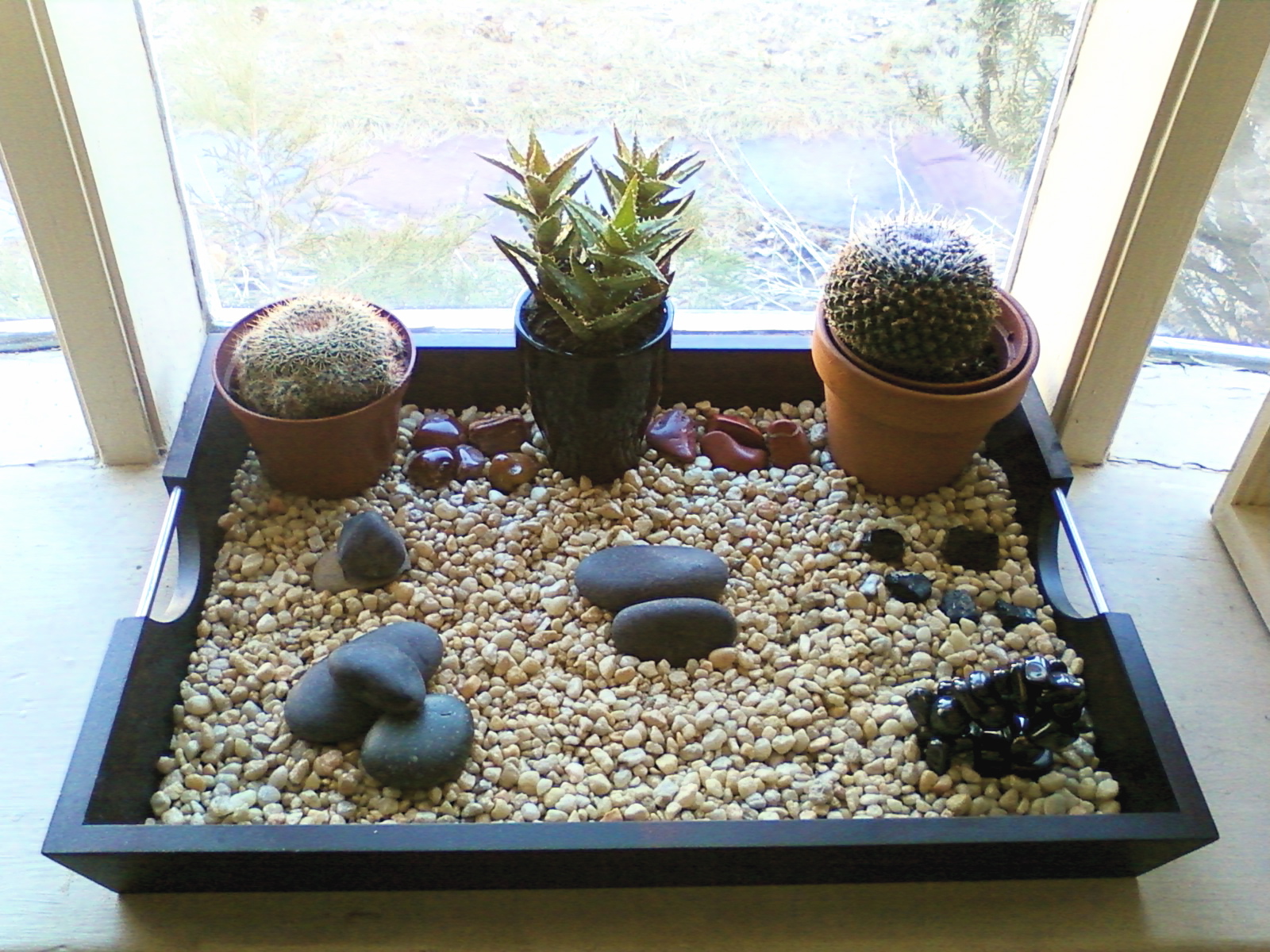
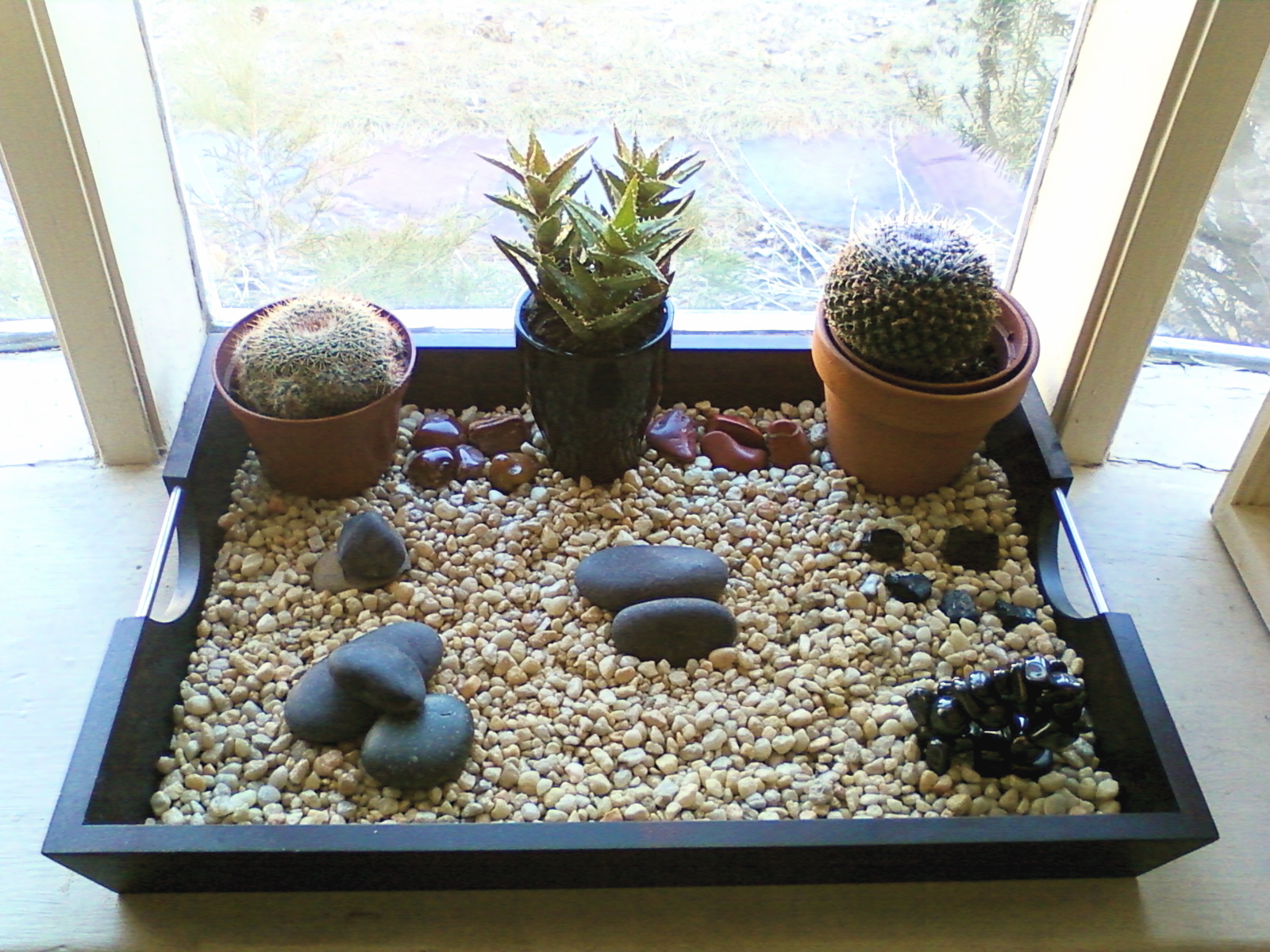
In a karesansui, the water of the “sea,” “lake,” or “river” is represented by gravel, and can either seem like a still pool, or be stylistically raked or arranged to evoke thoughts of water’s movement. Gravel can easily represent a vast, active ocean; for this effect the garden’s size need not be large at all, since the world of the garden is not realistic reproduction but imagination. The scale of the garden’s interrelated contents is more instrumental in creating the desired impression than the size of the garden itself. In my own dry garden, the light gravel represents the sea, the flat stones are low islands on the sea, and the black hematite formations are taller “rocky outcroppings” standing above the water. The plants form a backdrop landscape. They could communicate mountains and forests; or perhaps their juxtaposition with the rocks could simply suggest a desert landscape, with no water imagined at all. These gardens have such a heavy use of imaginative representation in order to give the mind a dedicated, free space in which to think about the world-scape that the garden stands for. This is a meditative act that feeds the mind.

All of this leads me to think about a few ways that American Christian worship could, in my view, renew itself. In Japan the landscape is dotted with small shrines, to which individuals may go for a few minutes on their own time to light incense, say a prayer, meditate, or simply feel in communion with that which is beyond oneself. The Catholic and Orthodox areas of Europe are also rich with shrines, as is Latin America; many of these involve saints as avenues to the worship of God. Protestantism, however, which represents just under one-half of United States religious practice, is lacking this, since Protestant theology resists such small shrines either outdoors or in the private home. Therefore, what Christian shrines America does have tend to be Catholic (and Orthodox to a lesser extent, since there are far more American Catholics than American Orthodox). These are very attractive in a spiritual sense, and this is true whether such shrines are public or private. It is a personal, active, “anytime” experience to visit a shrine.

These are a few thoughts from one who takes delight from a rock garden, from lighting candles, and from being in a place and hearing nothing but the wind and the birds outside.

© Elizabeth Keck 2010

__________________

*For an excellent and readable resource on Zen gardens, see Zen Gardens by Erik Borja.

Two Streams of Water

A few days ago, I set up the Japanese rock garden (or Zen garden), also known as dry garden (karesansui) that I mentioned in my last post. Here you will see two small pictures; each represents a different iteration of the rock garden. I ultimately settled on what is represented in the second picture, after having for a while what is represented in the first picture. Both are valid examples of how a rock garden can be arranged. The light gravel, raked to represent the rippling effect of water, represents the ocean; the large rocks stand for large islands rising from the sea; the background represents the land. The red rocks in the first picture indicate land, while the cacti and aloe represent various flora.

This morning I sat down on the couch with my coffee in front of it, watching the gold of the morning sun’s rays flood the window, listening to the scores of birds that arrive around our house every spring morning. These birds, in these quantities, are here for spring and summer only, so their presence is temporary. And the side of the house that harbors this window gets that strong sunlight only in the early morning, so the presence of those exuberant rays is even more temporary — at least until the next morning, provided it is a sunny one. The temporary nature of both the flocking birds and the full sunlight means that if they are not enjoyed now, in the very moment, you miss them. There is no taking them for granted.

Knowing this, I decided I would do nothing but sit in my spot, drink my coffee, and look at my karesansui and the trees outside my window. It was surprisingly difficult just to sit there and do that and nothing else — even with my knowledge that that full sunlight was very fleeting, and the flocking birds at their morning feeding almost equally so.

It occurred to me as I looked at my garden that that is one of the core lessons of Zen philosophy, core lessons of which I had hoped to remind myself by building the garden in the first place. Mindfulness, awareness, appreciation. Mindfulness is the act of being “mindful” of whatever it is you are doing, of truly living in the moment by paying attention to that moment rather than rushing past it. Driving somewhere, for example; enjoy the drive itself rather than merely trying to rush to your destination as expediently as possible. That drive is part of your life that you will never get back: enjoy it as much as you can. Or even if it is something we don’t think of ourselves as relishing — such as doing dishes, which is a famous example for this philosophy — we can savor our lives that much more if we simply focus our minds on the very thing we are doing. This in itself is a meditative act that creates both peace and enhanced enjoyment of life with hardly any effort at all. How often do we whittle our lives away by not living in each moment, by rushing ahead, by constantly thinking of something else? By constantly feeling — even in the times when it is not necessary — that we need to be doing something, to be distracted, to be “busy.”

Though I am a Christian, I keep a marble-dust representation of the Buddha near my rock garden  — not because I revere the Buddha in any extraordinary way, but to remind me of some of the more salient and helpful aspects of that philosophy, which are really not incompatible with Christianity. Mindfulness. Acceptance. Compassion. Living in the very present. Appreciating small, everyday things as the fundamental things of life. Creating and maintaining a peaceful, uncluttered space for the mind. Training one’s mind to be calm at its core even in the face of adversity. Living honorably and with integrity, creating no intentional harm against others, keeping Love and Compassion as one’s highest aims. All of these things Christianity and Buddhism can share in common, but only some of these do Christians actively emphasize on a regular basis. I contend that Christians could benefit in their own practice by more actively stressing some of those tenets of Buddhist philosophy discussed above. Zen practice, in particular, is especially adaptable for Christians.

Two representative aphorisms from the Dhammapada, the foundational Buddhist text, illustrate such confluence very well:

“In this world, hate never yet dispelled hate. Only love dispels hate. This is the Law, ancient and inexhaustible.”

“However many holy words you read, however many you speak, what good will they do you if you do not act upon them? Are you a shepherd who counts another man’s sheep, never sharing the way? Read as few words as you like and speak fewer. But act upon the Law. Give up the old ways — passion, enmity, folly. Know the truth and find peace. Share the way.”

And what reader of the Bible would not recognize the similarity of this aphorism to the style and content of Proverbs?

“Speak or act with an impure mind, and trouble will follow you as the wheel follows the ox that draws the cart.”

The lifting of a few quotes from an entire work cannot possibly encapsulate the whole, and that’s not my intention. This is as true of the Bible as it is of the Dhammapada. But it can illustrate that two distinct streams of water, remaining distinct, can still flow down the mountain in tandem with one another.

© Elizabeth Keck 2010

The Tangibility of the Intangible

This week I plan on crafting a miniature, indoor Japanese rock garden (karesansui) in a low wooden or bamboo box, to be placed on our bow window. A Japanese rock garden is sometimes also called a Zen dry garden due to its deep connection with Zen Buddhism. A rock garden, or karesansui, is a “dry landscape” garden; it employs no actual water, but the rocks, moss, and small shrubs that can constitute the garden are often arranged in a way that evokes thoughts of streams, mountains, hills, and even forests. Despite the fact that the arrangement of stones and small plants can create the illusion of water, a primary characteristic of these gardens is their sense of stillness.

My husband is an aficionado of Japanese culture; I am glad for this, because if he were not, I would never have been introduced to the robust appreciation of clean-lined tranquility that is Japanese aesthetics. Walk into any classically Japanese structure, such as a traditionally-appointed Japanese restaurant, and your mind will feel almost instantly at ease. The aesthetic usually involves light neutral color tones, tastefully limited and unobtrusive decor, and stunningly clean lines for everything. The absence of clutter, of haphazardness, of “too much” is felt immediately in the calming effect such an aesthetic has on the mind. With one’s space so calm, smooth and free-flowing, so uncluttered, how can one feel tense? It is as if when the body enters such an open space physically, the mind also enters an open space — one that does not impose upon it but rather invites it to relax in freedom.

This clean and simple aesthetic is also very conducive to thinking and to meditating, for obvious reasons. The same holds true for the rock garden. Its smoothness and stillness, punctuated by just the right amount of components, put our minds at ease and elevate them somehow. Something in the nature of these tangible things, of that tangible space, allows us to make contact with something intangible in which our minds delight. This is true not just of structures and spaces, of course. Jewelry has been around for thousands of years, as we know quite well not only from things like ancient Egyptian murals, but also from ancient jewelry itself, lifted from the ground by archaeologists or treasure hunters.

Many of us feel emotional connections to some of our jewelry; many of us wear certain articles because the design or the material makes us think of something, or is a symbol of something important to us. This is especially true of religious or spiritually-oriented jewelry. How many of us wear Stars of David, mezuzah pendants, crosses, crucifixes, Buddha pendants, yin/yang circles, Qur’an pendants, or even mineral rocks from the earth, because their tangibility links us to the intangible things they represent?

The same is true for other physical art — the David, the Sistine Chapel ceiling, St. Peter’s basilica (all right, I’m betraying a Michelangelo bias here), Buddhist temples, Monet’s paintings, the intricate aniconic designs of Muslim art, the bimah of Jewish synagogues. The rich statuary of most Catholic churches reflects the Catholic theology that it is not to the statue that a worshiper prays, and it is not the statue that has any power: the statue is a tangible symbol of the spiritual figure it represents.

The ancient world too, as I mentioned in another post, was rich with statues and figurines of the gods and various other religious artifacts. In ancient Mesopotamia, the statues of the gods were their physical vectors on Earth; when a statue was created and commissioned, its inauguration consisted of the ceremonies mish pi and pit pi — “washing of the mouth” and “opening of the mouth.” When these ceremonies were complete, the deity’s physical representation became formal and suitable for that deity.

All of these things, I think, are examples of the inextricable link between the tangible and the intangible. The tangibility of the Zen rock garden or the Japanese room, or some element within nature, directs our minds to something intangible and produces a feeling or a state of being. The tangibility of personal jewelry — which we often touch or hold in a moment of worry or gratitude or even just contemplation — connects us to the intangibility of what it represents. The tangibility of physical art — whether painted, drawn, sculpted, constructed, or written — touches us on a deep level, and can even transport us to some other world or some larger awareness. The tangibility of a religious statue serves as a vector for the reality beyond. For those of us who believe in an intangible soul that survives the body, the body is the tangible home of that soul in this world.

The tangible and the intangible of this cosmos, while so often thought of as separate and fundamentally different, in fact seem linked in deep and inextricable ways. I will think of this as I look at my Zen rock garden this week, and allow its tangible nature to point my mind to the intangible peace it represents.

© Elizabeth Keck 2010

Born in the Garden of Eden

The story of the Garden of Eden and the Fall of humankind (incidentally, the term “Fall” is never used in the biblical account) can be interpreted in many different ways by its religious inheritors. In the world of Christian interpretation, there are some that take this story only at its most literal face value. Adam and Eve were two historical individuals who ate a fruit [not necessarily an apple, since the Hebrew word pri can mean any fruit] because they were tempted by the serpent [not necessarily the devil, since the serpent might represent any tempting, deceptive impulse], and were kicked out of a real geographical Eden for violating God’s one command not to eat of the Tree of Knowledge of Good and Bad. Other Christians see this story as metaphor, a lesson on why life can be so far from the ideal world we are all capable of imagining. In classical Christian theology, it is a story (metaphor or otherwise) that details the arrival of imperfection and sin into the human experience, and explains why such things afflict all of us.

The Eden story seeks to provide the answer to some of life’s most troublesome realities: why childbirth, a joyous event, comes accompanied with unparalleled physical pain, and why a man can work in his fields until he has no skin left on his fingers and no sweat left in his body and the earth might still not yield enough to live on. And why even if it does, that yield cannot ever come forth without hard, physical dedication. In short, the Eden story recognizes that this world and that human life are imperfect, and seeks to tell us why. That, at least, is something on which both literalists and non-literalists can agree. Beyond that, literalists often believe the story is a straightforward one about how two people disobeyed God by giving in to greed and temptation, lost out on Paradise, and thereby doomed the rest of us to sin and the school of hard knocks. Non-literalists often believe the story is a quaint, perhaps somewhat embarrassing tale of origins that observes (1) life’s a bitch, and (2) why it’s a bitch.

To my mind, the essence of the story is neither of these. The Eden story is a sophisticated and multi-layered coming-of-age tale, a commentary on the point in time (and maybe that point could be a process over thousands of years) when humans came to know good and bad, truth and deception. That is to say, the point in time when humans became sentient as a species. When humans gained a knowledge and capability they had not had before: the knowledge that it is possible to deceive and to cause gratuitous harm with aforethought for one’s own gain, or worse, pleasure. The serpent, which I take to represent all those capabilities we have and wish we didn’t, tempted Adam and Eve — the prototypical humans — to eat of the Tree of Knowledge of Good and Bad, even though God had warned them not to. And they did. The serpent’s “promise”? That they would become like gods, that they would become wise.

This is a story in which God finds out that Adam and Eve had eaten of the Tree when God goes for a stroll one evening to enjoy the cool part of the day. This is not a literal story and it was never intended to be, to my mind. God had told the humans they could eat of any tree except the forbidden one, for the day they ate of that one, they would surely die. It seems to me that they did die when they ate of the Tree, but not by a stopping of the heart. What died was the creature — the species — they had been before gaining such knowledge.

The Garden of Eden is a story that describes the loss of innocence; I believe, the loss of innocence as a species. Innocence is not the quality of being good all the time (any parent of a child can tell you that). Innocence is the state of not knowing — of not being capable of hurting someone or something as a result of deliberately intending to do so. And the innocent being is not capable of that because the innocent being does not even know such a thing is possible; such a being cannot think of doing that because that awareness does not yet exist within its mind. It is not yet wired for it. Most animals are innocent in this way: they might cause harm or kill, but they do so either to eat or to defend themselves, their group, or by extension their home territory. They do not cause hurt out of malice, deception, or for kicks.

Some of us are still in Eden, in a way. Among humans, innocence still lives — in very young children. This does not mean young children are always paragons of behavior. But it means that very young children do not think to themselves: “I want to hurt mommy’s/daddy’s/my friend’s feelings, so I will do x-y-z and hurt their feelings that way.” A very young child might do or say something that does hurt someone else, but they are not doing so in a knowing fashion, or for pleasure, or for some selfish gain. They are going on what they want or feel in the moment, without aforethought. I say “very young children” because eventually, children do get to an age — biologically, get to a point in their brain’s wiring — where hurting someone else because they want to, or because it benefits them in some way, becomes possible. At that point, they are no longer in Eden. Even if, hypothetically, they never intentionally hurt another being, they are aware that such a capability exists and that there are people who do it. That is the fruit of the Tree of Knowledge of Good and Bad.

In that sense, it seems to me that the Eden story not only tells of a species’ development from innocence to knowledge of good and bad, but also of each individual within that species. Very young children are innocent, and it is our job to teach them how to treat other living beings in preparation for the time when they grow older. That job is a sacred responsibility. It is all the more sacred because another quality of the innocence of a young child is the implicit trust that child has. Children have a capacity for trust that humbles us. You could tell a small child the sky is blue because God colored it that way with God’s Crayola marker, and that small child could very well believe you. At night when I give my child her allergy medicine, it strikes me how completely she trusts that what I am giving her will cause her no harm. She has no apparatus for doubting that, and the sweetness of that trust speaks to me.

All of this, I believe, is what Jesus meant when he told the disciples not to prevent parents from bringing their little children to him. As recorded in Mark 10:13-16, the disciples thought the children would bother him, but Jesus’ response was emphatically the opposite. He said, “Allow the little children to come to me; do not stop them, for to these belongs the Kingdom of God. Very truly I tell you, unless you receive the Kingdom of God like a little child, you will never enter it.” Then Jesus gathered the children into his arms and blessed them.

Knowledge of good and bad, in addition to all of the above, also extends to the awareness that bad things happen in the world. My young daughter accidentally caught sight of a photo of the Polish plane after it had crashed to the ground, and she said with furrowed brow: “Oh, the plane fell out of the sky! Oh, the plane is sad.” Then, after thinking another moment, she brightened up: “Slinky can help! Yeah, Slinky can help get the plane off the ground.” No knowledge of the tragedy involved — and at her age, I intend to keep it that way. Hers was a lack of knowledge of the scale of what had gone wrong, and hers was a sweet and simple desire to help, and then happily going to read her bedtime story with us. That is innocence, and I will preserve that for her as long as possible — even while teaching her how we as humans should behave in the world outside of it.

© Elizabeth Keck 2010

When Home is 93 Billion Light Years Around

In 2004, the Hubble space telescope completed a picture it had been taking for about four months. The result was what we now know as Hubble Deep Field. (To see this image, simply Google those words and it will be the top hit.) In the picture, seemingly countless separate galaxies are everything you see. To be specific: ten thousand of them, all inhabiting a point in space that to our naked eye is the size of a pencil tip. The fateful image, which altered the way we visualize the universe, came to be after astronomers decided to point Hubble at a tiny, seemingly empty dot in space — black, nothing discernible, totally unremarkable. Just to see what was there.

There is no other image that more fully impresses upon us — or allows us better to imagine — the scale of the universe. Ten thousand galaxies in the area of a pencil tip, including some that are so far away they appear as a bright red, cause us to think about who we are and who God is. Red shift, the phenomenon that causes an object to appear red when it is moving away from us at high speed (this is considered the Doppler effect of light), helped astronomers to calculate that a few of these galaxies were around 12 billion light years away from us. This, of course, means that the light that has traveled to us from those galaxies, allowing us to see them, has been traveling for 12 billion years. So we are only permitted to view those galaxies as they would have been 12 billion years ago; incidentally, this is the only way we know of to “look back in time.” And there is no way for us to know what those same galaxies might look like right now, provided they still exist.

But those 12 billion years mean that those particular galaxies are nearly as old as the universe itself. Astronomers quite accidentally stumbled upon the age of the universe when they noticed strange background microwave radiation unevenly distributed throughout space at a temperature of three degrees above absolute zero. The astronomers realized that this radiation was in fact the “afterglow” or “echo” of the Big Bang. The existence and character of the background radiation allowed them to calculate the age of our universe at close to 14 billion years. 14 billion years ago, the Big Bang happened. To put things in a little more perspective, the star that we call our Sun is somewhere between five and six billion years old.

To this point, astronomers have actually discovered a staggering 100 billion galaxies, and in each of those galaxies burns 100 billion stars like the Sun. The number of planets encircling 100 billion times 100 billion (10 septillion) stars is incalculable. As for the massive scale of the larger universe in which all these galaxies reside, our observable universe runs 93 billion light years in circumference.

In the ancient world, peoples of many different nations (ancient Egypt, Sumeria, Babylonia, the many small Canaanite nations, Israel, Greece, etc.) believed the gods lived in the Heavens. But they also believed that those gods were present in their temples and shrines; inhabiting more than one location simultaneously was not impossible for a deity, and temples were typically thought of as microcosmic sacred spaces that represented a connection between Heaven and Earth. Though this was widely true in many ancient cultures, in the case of Israel it is illustrated nicely in several biblical texts, perhaps most notably Isaiah 6. In this chapter, Isaiah witnesses the inside of Yahweh’s Temple, which is filled merely with the bottom hem of Yahweh’s robes as he sits on his throne. The massive figure of God extends upward through the Temple into the Heavens, where serpentine, winged flaming seraphim hover near him (the Hebrew word saraph means “to burn”).

People also gravitated toward statues and figurines of the divine, some of which could be kept in people’s houses and/or in small shrines as part of a kind of local or in-home worship. No figurines of Yahweh have been discovered — probably due to the aniconic emphasis involved with his worship — but we have found figurines of Baal, for example, and many other deities across the ancient Near East. The famous ancient Israelite “pillar figurines” found inside homes could also be meant to represent a goddess(es) of fertility, though this is not certain. My purpose in mentioning these things is to point out that people have tended always to identify God or gods as having some connection with and even some location on Earth, even in tandem with the awareness that the full home of God or gods transcended Earth into the Heavens. We have still always identified God as close to us somehow, transcendent but also immanent.

With the knowledge of the cosmos that we have today, that of a place so vast and complicated that it eludes our comprehension utterly, some of us think it time to leave behind these ancient conceptions. People understandably think that it is now ill-informed and grossly arrogant to continue thinking of ourselves as anything special, as anything on which God would spend much time. Our planet is already a tiny speck even in our own galaxy the Milky Way, and we orbit one fairly standard star amidst 100 billion such stars just in the Milky Way alone. Even leaving it at that is enough to cause us to look at ourselves a bit askance. Add consideration of what lies beyond our own galaxy — 100 billion other galaxies — and to think of ourselves as anything to attract God’s attention becomes preposterous, laughable, hubristic, or just blindly stubborn. Who are we, after all?

I understand such thoughts, and in a positive way, they are a sign of a very welcome humility after so many centuries of disproportionate human pride. But my approach is somewhat different. I do think it ridiculous to imagine that we are the only intelligent life in this vast universe; but I do not consider the certain abundance of that life to be evidence of our intrinsic insignificance. Nor do I consider the smallness of our Earth within this 93 billion-light-year-round universe to be evidence of our insignificance. If our species is small and is one among potential millions, then by extension, each and every one of those other species is also one among millions. Such species are not intrinsically more “important” than we are simply by virtue of their being not-us. The same is true for our planet, a “pale blue dot” that with distance may indeed appear as “a mote of dust suspended in a sunbeam” (Carl Sagan), and eventually disappear into imperceptibility. For the same is true also of each planet orbiting any of the 10 septillion stars in the universe.

Knowledge of “our place in the universe” is a necessary corrective for exaggerated egos, and, it is to be hoped, a wondrous impetus for us to spend some time appreciating the Creator of this universe. But it is not a sentence of futility, of denigration, of lack of worth. To say that it is so would be to pronounce the same sentence on every single one of those potential millions out there beyond our galactic neighborhood. A precious thing is not any the less precious for being in the company of other precious things, any more than a single human could be deemed not precious because there are 6 billion such humans. I am not daunted in thinking of the certain abundance of life in God’s universe; I am oddly reassured and encouraged.

This is our home, as much as it is the home of 100 billion other galaxies. Even when home is 93 billion light years around, one member of the family is not any the less beloved to the Head of Household.

© Elizabeth Keck 2010

_______________

**Much of the information regarding astronomy in this post is courtesy of PBS’ “Nova: Hunting the Edge of Space.”